Is the Rainbow Mountain in Peru Worth a Visit? An Honest Guide to Vinicunca's Colorful Peaks
Rainbow Mountain Peru — also known as Vinicunca or Montaña de Siete Colores — has exploded in popularity over the past decade. Instagram feeds overflow with images of hikers posing in front of its candy-striped slopes, and tour operators in Cusco promote it as a must-do excursion. But behind the stunning photos lies a challenging high-altitude trek that is not for everyone. So is Rainbow Mountain worth it? In this guide we share our honest experience, break down costs, explain the geology behind those famous colors, and help you decide whether Vinicunca deserves a spot on your Peru itinerary.
What Is Rainbow Mountain (Vinicunca)?
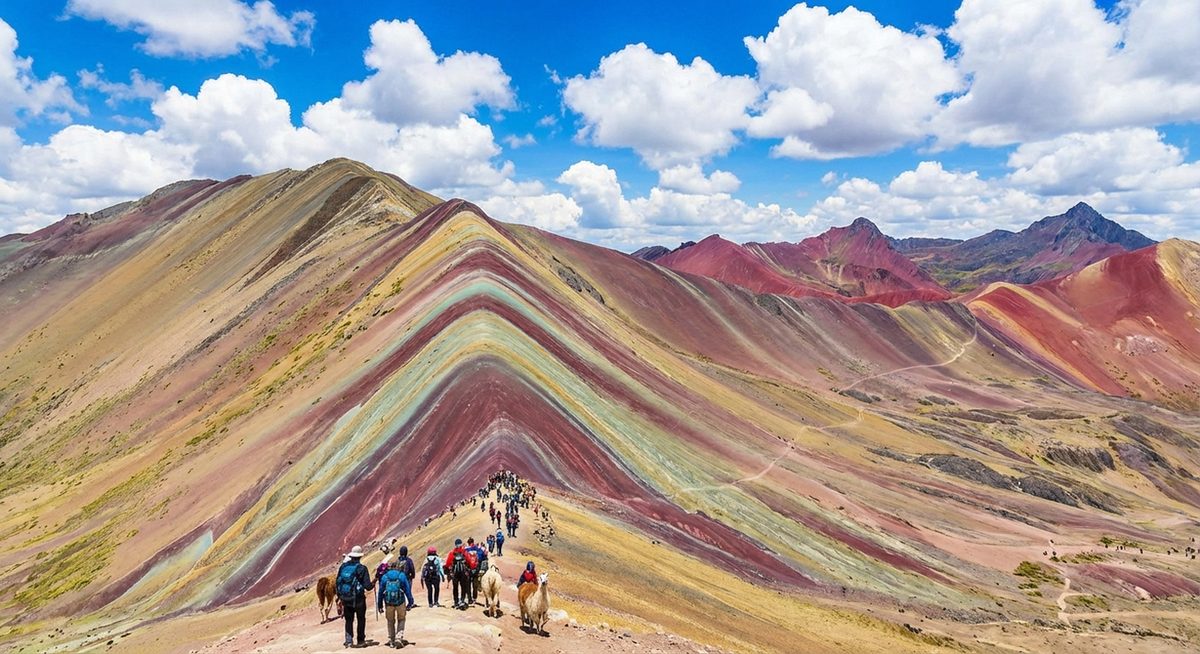
Rainbow Mountain, officially called Vinicunca, is a geological formation in the Cusco Region of southeastern Peru. Sitting at approximately 5,200 meters (17,060 feet) above sea level, it is part of the Ausangate mountain range in the Vilcanota Range of the Andes. The mountain's claim to fame is its striking bands of color — red, gold, lavender, turquoise, and green — that stretch across its slopes like layers of a geological cake.
Until around 2015, Vinicunca Peru was virtually unknown to tourists. Climate change melted a thick layer of snow and ice that had covered the mountain for centuries, revealing the mineral deposits beneath. Once the colors emerged, photographs went viral on social media, and what was once a remote Andean ridge became one of Peru's most visited natural attractions almost overnight.
The nearest town is Pitumarca in the Canchis Province, roughly 100 kilometers southeast of Cusco city. Most visitors access Vinicunca through organized day tours departing from Cusco, though independent trekkers can also arrange transportation to the trailhead at Quesiuno or Pampachiri.
How the Colors Formed: The Geology Behind Rainbow Mountain
The spectacular banding of Rainbow Mountain Peru is the result of millions of years of sedimentary mineral deposits combined with tectonic uplift. Each color corresponds to a different mineral composition within the layers of rock and soil:
- Red and maroon: Iron oxide (rust), the same mineral that gives the Grand Canyon its warm tones.
- Yellow and gold: Iron sulfide and limonite, formed through the oxidation of iron-bearing minerals in the presence of water.
- Green and turquoise: Chlorite, a mineral group common in metamorphic rocks that forms under heat and pressure deep underground.
- Lavender and pinkish-white: A mixture of red sandstone with calcium sulfate or manganese-bearing minerals.
- Brown and tan: Fanglomerate, a rock composed of gravel and clay cemented together by groundwater minerals.
These layers were originally deposited horizontally on ancient lake beds and river deltas over a span of roughly 65 million years. When the Nazca tectonic plate collided with the South American plate, the Andes were pushed upward, tilting and folding these formerly flat sediments into the steep, exposed bands visible today. The recent retreat of glacial ice — a consequence of rising global temperatures — uncovered what had been hidden for thousands of years.
How to Get There: Tours From Cusco
The vast majority of visitors reach Vinicunca on organized day tours from Cusco. Here is what a typical tour day looks like:
- 3:00–4:00 AM: Your tour operator picks you up from your hotel in Cusco.
- 6:30–7:00 AM: Arrive at the trailhead after a roughly three-hour drive through the Andes. A basic breakfast is usually served at a small settlement near the start.
- 7:00–10:00 AM: Hike to the viewpoint. The trail covers approximately 5 kilometers one-way with an elevation gain of about 400 meters.
- 10:00–11:00 AM: Time at the summit viewpoint for photos and to take in the scenery.
- 11:00 AM–1:00 PM: Hike back down, optional detour to Red Valley (Valle Rojo).
- 1:00–2:00 PM: Lunch at the base, then the three-hour drive back to Cusco.
- 5:00–6:00 PM: Return to your hotel.
If you prefer going independently, you can hire a private driver from Cusco to Pitumarca and arrange a local guide at the trailhead. This gives you more flexibility with timing but costs significantly more. Some multi-day trekkers incorporate Vinicunca into a longer Ausangate Circuit trek, which offers a far more immersive experience of the region. For other great day trips and treks from Cusco, see our guide to Choquequirao and how to visit it.
Difficulty and Altitude Sickness
This is where honesty matters most. The hike to Rainbow Mountain is not technically difficult — the trail is a well-worn path with no scrambling, ropes, or exposed ridges. However, the altitude makes it genuinely tough. At 5,200 meters, you are higher than Everest Base Camp in Nepal. The air contains roughly 50 percent less oxygen than at sea level.
Common symptoms at this altitude include:
- Shortness of breath after just a few steps
- Headache, sometimes severe
- Nausea and loss of appetite
- Dizziness and lightheadedness
- Fatigue that feels wildly disproportionate to the physical effort
Our honest advice: Spend at least two to three full days acclimatizing in Cusco (3,400 meters) before attempting Vinicunca. If you have just arrived from sea level, do not attempt the hike — altitude sickness at 5,200 meters can be dangerous. Many travelers who rate Rainbow Mountain poorly in reviews made the mistake of going too soon after arriving in Cusco.
Horses are available for hire at the trailhead (typically 70–100 soles, roughly $20–30 USD) and will carry you about 80 percent of the way. The final 20 percent is too steep for horses, so you will still need to walk the last stretch on foot. Coca tea and coca candies help some travelers manage mild symptoms, and your tour guide may carry a small oxygen tank for emergencies.
Best Time to Visit Rainbow Mountain
The dry season from June through October offers the clearest skies and the most vivid display of colors. This is when Vinicunca Peru looks closest to the Instagram photos — bright sunshine illuminates each mineral layer, and the mountain practically glows against a deep blue sky.
During the wet season (November through March), the trail becomes muddy and slippery, clouds frequently obscure the summit, and fresh snow can cover the colorful bands entirely. Many travelers who visit during this period report disappointment because the mountain appears mostly brown or white under overcast skies.
That said, visiting in the shoulder months of May or late October can offer a good compromise: fewer crowds than peak season but still reasonable weather. Early morning visits (which all day tours provide by default) tend to have the best conditions regardless of season.
If you are planning a broader trip, these timing considerations align well with the best season for visiting Peru's top destinations including Machu Picchu, Cusco, and the Sacred Valley.
The Alternative: Red Valley (Valle Rojo)
Many experienced Peru travelers argue that Red Valley, located just a short detour from the Rainbow Mountain trail, is actually the more impressive sight. Valle Rojo is a wide valley of deep crimson-red earth flanked by ridges of the same colorful mineral deposits found on Vinicunca itself, but on a much larger and more dramatic scale.
The Red Valley detour adds approximately 30–45 minutes to your hike (one-way) and descends slightly from the Rainbow Mountain viewpoint, making it somewhat easier on the lungs. The panorama is vast and sweeping, with far fewer tourists than the main Rainbow Mountain summit, which tends to get crowded during peak hours.
Our recommendation: if your body and energy levels allow it, absolutely include Red Valley in your itinerary. Ask your tour operator in advance whether the schedule permits this detour — most standard tours now include it, but budget operators may rush you back without mentioning it.
Honest Pros and Cons of Visiting Rainbow Mountain
Pros
- Genuinely unique geology: There is nothing quite like it anywhere else in the world. The color bands are real and, on a clear day, absolutely stunning.
- Cultural experience: The drive through remote Andean communities offers a glimpse of traditional life, including herds of alpacas and llamas grazing at extreme altitudes.
- Red Valley bonus: The optional detour to Valle Rojo is arguably even more impressive and sees far fewer crowds.
- Sense of accomplishment: Reaching 5,200 meters on foot is a legitimate achievement, and the views from the top extend across the entire Vilcanota Range.
- Affordable: Day tours from Cusco start at around $15–25 USD for budget options, making it one of the cheapest major excursions in the region.
Cons
- Altitude is brutal: Even well-acclimatized hikers feel the effects at 5,200 meters. For some visitors, the physical discomfort overshadows the experience entirely.
- Crowded at peak times: During June through August, hundreds of tourists arrive simultaneously, creating long lines at the viewpoint and diminishing the sense of wilderness.
- Long travel day: With a 3:00 AM pickup and a 5:00–6:00 PM return, the tour consumes an entire day and leaves you exhausted.
- Weather dependent: Clouds, rain, or fresh snow can completely ruin the view. There are no refunds if the weather does not cooperate.
- Overtourism concerns: The rapid increase in visitors has led to trail erosion, litter, and disturbance to local communities and grazing lands. Some conservationists question whether current visitor numbers are sustainable.
Cost Breakdown: How Much Does Rainbow Mountain Cost?
Here is what you can expect to pay for a Rainbow Mountain Peru day trip in 2026:
- Budget group tour: $15–30 USD per person. Includes transport, breakfast, lunch, and guide. Large groups of 20–40 people.
- Mid-range group tour: $40–60 USD per person. Smaller groups, better meals, English-speaking guide, oxygen tank included.
- Private tour: $100–200 USD total for two people. Flexible schedule, personal guide, more time at the summit.
- Entrance fee: 10 soles (approximately $3 USD), payable at the trailhead. This fee goes to the local community of Pitumarca.
- Horse rental: 70–100 soles ($20–30 USD) for a horse that carries you most of the way up.
- Walking stick rental: 10–15 soles ($3–5 USD), useful for stability on the steeper sections.
- Tips: 20–30 soles for your guide and 10–15 soles for the driver are customary.
All told, a budget-conscious traveler can do the entire trip for under $25 USD including tips, while a premium private experience might run $120–150 per person. Compared to similar natural attractions worldwide, Vinicunca offers exceptional value.
What to Bring on the Hike
Packing the right gear makes a significant difference in your comfort and safety at extreme altitude. Here is our recommended packing list:
- Layers: Temperatures at the trailhead can be below freezing at dawn but climb to 15–20°C in direct sunshine. A base layer, fleece, and waterproof shell are essential.
- Sun protection: At 5,200 meters, UV radiation is intense. Bring SPF 50+ sunscreen, UV-blocking sunglasses, and a wide-brimmed hat.
- Water: At least 1.5 liters. Dehydration accelerates altitude sickness.
- Snacks: Energy bars, chocolate, or dried fruit. You will burn more calories than expected.
- Coca leaves or candy: Available at markets in Cusco and at the trailhead. Locals swear by them for altitude relief.
- Cash in soles: For the entrance fee, horse rental, walking sticks, and tips. There are no ATMs anywhere near the trailhead.
- Camera: Obviously. A polarizing filter helps bring out the colors on sunny days.
- Rain gear: Even in dry season, afternoon showers are possible at this altitude.
Alternatives to Rainbow Mountain
If the altitude concerns you, or if you want to experience the Cusco region in a less crowded way, consider these alternatives:
- Palccoyo Rainbow Mountain: Often called the "alternative Rainbow Mountain," Palccoyo sits at a lower elevation (4,900 meters) and requires only a 30-minute walk from the parking area. The colors are equally vivid, the crowds are a fraction of Vinicunca's, and the trek is accessible to a much wider range of fitness levels.
- Ausangate Trek: A multi-day circuit around Ausangate (6,384 meters), passing Vinicunca on one of the middle days. This is for experienced trekkers only but offers some of the most dramatic Andean scenery in Peru.
- Humantay Lake: A stunning turquoise glacial lake at 4,200 meters, reachable on a half-day hike from the Salkantay trailhead. Lower altitude, equally photogenic, and a good warm-up for higher treks.
- Choquequirao: The "sister city" of Machu Picchu, Choquequirao receives a fraction of the visitors and offers a far more adventurous multi-day trek through dramatic canyon scenery.
Combining Rainbow Mountain With Cusco Exploration
Most travelers visit Rainbow Mountain as part of a longer stay in the Cusco region. If you have several days in the area, you can easily combine Vinicunca with other highlights. The city of Cusco itself is packed with history, markets, and incredible food. The Sacred Valley offers ruins, traditional villages, and adventure sports. And for a completely different kind of experience, consider exploring some of Cusco's hidden gems at a more relaxed pace.
A sensible itinerary might look like: Day 1–2 acclimatize in Cusco, Day 3 Sacred Valley, Day 4 Rainbow Mountain, Day 5 recovery day, Day 6 Machu Picchu. This spacing gives your body time to adjust and prevents you from burning out on back-to-back high-altitude excursions.
Environmental and Social Impact
The rapid rise of Rainbow Mountain tourism has brought both benefits and challenges to the local Pitumarca community. On the positive side, entrance fees, horse rentals, and small businesses at the trailhead have created a new source of income for families who previously relied solely on subsistence farming and alpaca herding.
On the other hand, the sheer volume of visitors — sometimes exceeding 1,000 per day in peak season — has caused trail erosion, waste management problems, and disruption to traditional grazing patterns. The local municipality has introduced basic infrastructure such as portable toilets and trash collection, but enforcement remains inconsistent.
As a responsible visitor, you can minimize your impact by sticking to marked trails, carrying out all your trash, using the provided toilet facilities, and choosing tour operators who pay fair wages to local guides and porters. If possible, visit during the shoulder season when crowds are smaller and the environmental load is lighter.
Frequently Asked Questions About Rainbow Mountain Peru
Is Rainbow Mountain Peru worth it?
For most travelers who are properly acclimatized and visit during the dry season, yes. The geological formations are genuinely spectacular and unlike anything else in the world. However, if you are arriving directly from sea level without acclimatization days, or if you are visiting during the rainy season, you may find the experience disappointing. The key factors that determine whether it is "worth it" are your fitness level, how well you handle altitude, and whether the weather cooperates on your visit day. If in doubt, consider the lower-altitude alternative at Palccoyo, which offers similar colors with far less physical strain.
How hard is the hike to Vinicunca?
The trail itself is straightforward — a well-worn dirt path with moderate inclines and no technical sections. On a flat surface at sea level, anyone in average fitness could complete it easily. The challenge is entirely due to altitude. At 5,200 meters, every step requires more effort, and even fit hikers find themselves stopping frequently to catch their breath. Most people complete the 5-kilometer one-way trek in 1.5 to 3 hours depending on their pace and acclimatization. Horses are available to cover about 80 percent of the distance if you are struggling.
Can children visit Rainbow Mountain?
It is not recommended for children under 10 due to the extreme altitude. Children are more susceptible to altitude sickness, and the long early-morning drive combined with the physical exertion makes it a grueling day even for adults. If you are traveling with younger children, Palccoyo at 4,900 meters with a 30-minute walk is a safer and more manageable alternative. Some families with older teenagers (14+) do complete the Vinicunca hike successfully, provided they have spent adequate time acclimatizing in Cusco first.
What is the best month to see Rainbow Mountain?
July and August offer the most consistently clear skies, but they are also the most crowded months. June and September provide a good balance of favorable weather with slightly fewer visitors. May and October are shoulder months where you might get lucky with clear mornings but face a higher risk of afternoon clouds or rain. Avoid December through March entirely, as heavy rain and snowfall frequently obscure the colors and make the trail dangerously slippery.
Do I need a guide for Rainbow Mountain?
While it is technically possible to visit independently by hiring a taxi from Cusco to Pitumarca and walking from the trailhead, we strongly recommend going with a guide or organized tour. The trail is at extreme altitude where medical emergencies can develop quickly, and having someone with experience, an oxygen tank, and knowledge of the route is a valuable safety net. Additionally, organized tours handle the logistics of the 3:00 AM departure and provide meals, saving you considerable hassle.
Are the colors of Rainbow Mountain real or enhanced in photos?
The colors are real, but most published photographs are taken with polarizing filters and enhanced saturation in post-processing. In person, on a clear sunny day, the mountain is genuinely colorful and impressive, but the hues are somewhat more muted than the most viral Instagram shots. Overcast conditions or flat lighting can make the colors appear dull. The best natural lighting occurs between 9:00 and 11:00 AM, which coincides with when most tour groups arrive at the summit viewpoint.
What is the difference between Vinicunca and Palccoyo Rainbow Mountain?
Vinicunca (the original Rainbow Mountain) sits at 5,200 meters and requires a strenuous 5-kilometer hike. Palccoyo, often called the alternative Rainbow Mountain, is at 4,900 meters and requires only a 30-minute walk from the parking area. Palccoyo actually has three distinct colorful ridges rather than one, and it sees far fewer tourists. The trade-off is that Vinicunca offers a more dramatic single viewpoint and a greater sense of accomplishment. Many travelers with limited time or altitude concerns find Palccoyo to be the better choice.
Can I visit Rainbow Mountain without a tour from Cusco?
It is technically possible to visit independently by hiring a taxi or private driver from Cusco to the trailhead near Pitumarca. However, this is more expensive than a group tour and requires you to arrange your own meals and navigate without a guide at extreme altitude. For safety reasons, especially given the risk of altitude sickness at 5,200 meters, traveling with a guide who carries an oxygen tank and knows emergency protocols is strongly recommended for most visitors.
Final Verdict: Should You Visit Rainbow Mountain Peru?
Rainbow Mountain Peru is a genuinely remarkable natural wonder that deserves its reputation as one of South America's most visually striking landscapes. The geological story behind those colorful bands is fascinating, the surrounding Andean scenery is majestic, and the sense of accomplishment upon reaching the summit at 5,200 meters is hard to beat.
That said, it is not for everyone. If you are short on time, have not acclimatized, or are visiting during the wet season, your experience may fall short of expectations. In those cases, the lower-altitude Palccoyo alternative or a trip to Humantay Lake may deliver better value for your limited schedule.
For travelers who arrive in Cusco with a few acclimatization days to spare and plan their visit during the dry season, Vinicunca is absolutely worth the early wake-up call and the challenging hike. Just manage your expectations, pack appropriately, and consider adding Red Valley to your itinerary for an even richer experience. You can find more incredible Peruvian destinations in our guide to the top 10 destinations to visit in Peru.