Questions in Peru's Driving License Test: What to Expect and How to Pass
Getting a driving license in Peru (licencia de conducir) involves a written knowledge test and a practical driving exam administered by the Ministerio de Transportes y Comunicaciones (MTC). Whether you are a Peruvian citizen applying for the first time, a foreigner looking to drive legally during an extended stay, or someone who needs to convert a foreign license, this guide covers the test structure, the types of questions you will face, sample questions with explanations, and practical tips to pass on your first attempt.
The written test is where most applicants struggle, especially foreigners unfamiliar with Peru-specific traffic regulations. The exam draws from a question bank of over 2,000 items covering road signs, right-of-way rules, speed limits, penalties for infractions, vehicle maintenance, first aid, and environmental regulations. You will face 40 questions and need to answer at least 35 correctly (87.5 percent) to pass. The test is available in Spanish only at most MTC locations, though some offices in Lima offer it in English. Before diving into the specifics, familiarize yourself with general practical tips for living in and navigating Peru.
Peru's Driving License Categories Explained
Peru uses a category system that determines what vehicles you are authorized to drive. Understanding which category you need is the first step in the licensing process.
Class A (Professional Licenses):
- A-I: Taxis, vans, and vehicles transporting up to 8 passengers for commercial purposes. This is the most common professional category.
- A-IIa: Buses and vehicles transporting 9 to 32 passengers.
- A-IIb: Large buses transporting more than 32 passengers.
- A-IIIa: Commercial cargo vehicles up to 15 tonnes.
- A-IIIb: Heavy cargo vehicles over 15 tonnes.
- A-IIIc: Articulated trucks, tankers, and vehicles transporting hazardous materials.
Class B (Non-Professional Licenses):
- B-I: Private vehicles (cars, SUVs, pickup trucks) for personal use. This is what most people, including foreigners, apply for. Allows vehicles up to 3.5 tonnes with up to 9 seats.
- B-IIa: Minibuses or passenger vehicles seating 10 to 16 for non-commercial use (such as company shuttles).
- B-IIb: Motor homes and specialized recreational vehicles.
- B-IIc: Non-commercial vehicles towing trailers over 750 kilograms.
Most visitors and expats need the B-I category. If you hold a valid license from your home country and are staying in Peru for less than six months, you can drive with your foreign license accompanied by an official Spanish translation. For stays longer than six months or for permanent residents, obtaining a Peruvian license is legally required.
The Written Test Structure and Format
The written test (examen de conocimientos) is a computerized multiple-choice exam taken at authorized MTC testing centers. Here is what to expect on test day:
- Number of questions: 40 (for B-I category; professional categories have 40 to 50 questions with more specialized content)
- Passing score: 35 out of 40 correct (87.5 percent)
- Time limit: 40 minutes
- Format: Multiple choice with 4 options per question
- Language: Spanish (English available at select Lima locations upon request)
- Question source: A published question bank (Balotario de Preguntas) available on the MTC website
Questions are randomly selected from the bank, so every test is different. The questions cover seven major areas: road signs and signals, traffic rules and regulations, right-of-way rules, speed limits and safe driving, penalties and infractions, vehicle mechanics and safety, and first aid and emergency procedures.
Road Signs and Signal Questions
Roughly 25 to 30 percent of the test focuses on road signs. Peru uses the international Vienna Convention sign system with some local additions. You need to recognize three categories of signs:
Regulatory signs (senales reguladoras): These are circular signs with red borders that indicate obligations or prohibitions. Examples include speed limits, no-entry, no-overtaking, and mandatory turn directions. A common test question shows a circular red-bordered sign with a number and asks what it means. Remember that in Peru, speed limit signs show the maximum speed in kilometers per hour, not miles.
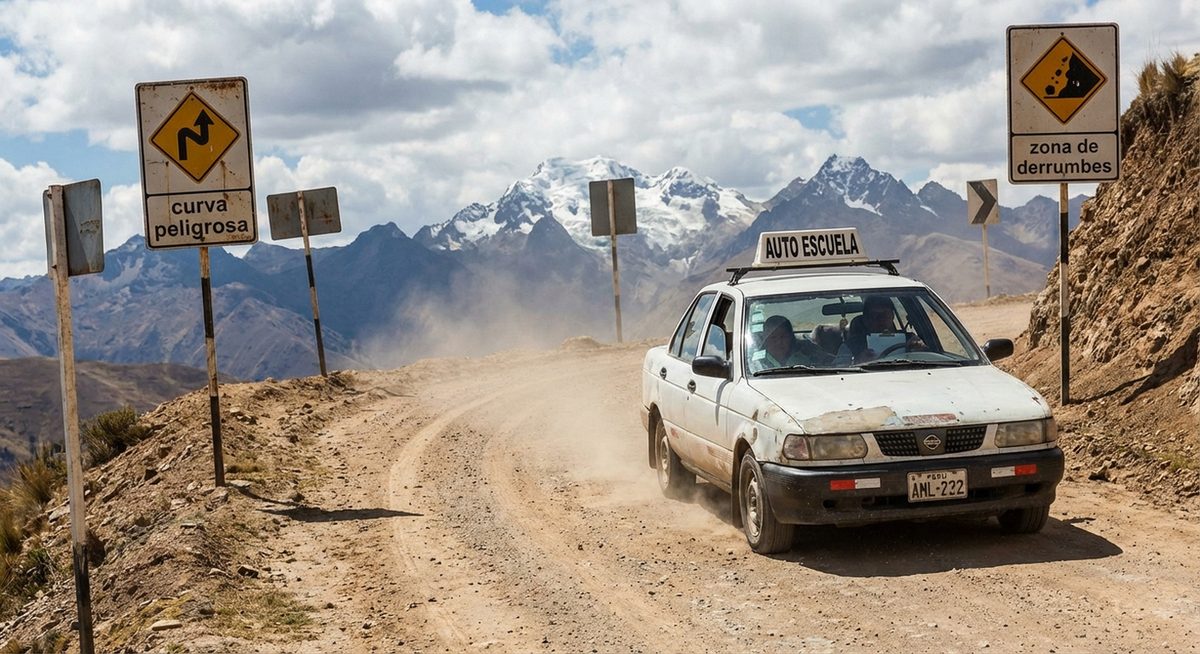
Warning signs (senales preventivas): Yellow diamond-shaped signs that alert drivers to upcoming hazards. Expect questions about signs for curves, intersections, pedestrian crossings, school zones, steep gradients, and animal crossings. Peru has specific warning signs for conditions common in the Andes, such as falling rock zones (zona de derrumbes) and fog areas (zona de neblina).
Information signs (senales informativas): Green or blue rectangular signs that provide directions, distances, and service locations. Questions about these signs tend to focus on highway route markers, hospital indicators, and emergency phone locations.
Sample question: A circular sign with a red border containing two cars side by side with a red X means: (a) no parking, (b) no overtaking, (c) no entry for two vehicles, (d) no lane changing. The correct answer is (b) no overtaking (prohibido adelantar).
Traffic Rules and Right-of-Way Questions
This section tests your knowledge of Peru's Reglamento Nacional de Transito (National Traffic Regulations). Key areas include:
Right-of-way at intersections: In Peru, vehicles approaching from the right have priority at unmarked intersections. This is a frequently tested rule. When two vehicles arrive at an intersection simultaneously and there are no signs or signals, the vehicle on the right has the right of way. Emergency vehicles with sirens and lights active always have priority regardless of direction.
Roundabout rules: Vehicles already inside the roundabout (rotonda) have priority over those entering. You must always circulate counter-clockwise (to the right) and signal before exiting. Test questions often present scenarios where two vehicles approach a roundabout and ask which one must yield.
Pedestrian priority: Pedestrians have the right of way at marked crosswalks (cruceros peatonales) at all times. At intersections without marked crosswalks, pedestrians still have priority when they have already begun crossing. This is one of the most commonly tested topics because Peru is actively trying to improve pedestrian safety. If you are wondering about general road safety in the country, our safety guide for tourists in Peru covers this and more.
Overtaking rules: Overtaking is only permitted on the left side. You must never overtake on curves, hills, bridges, tunnels, intersections, or within 100 meters of a pedestrian crossing. The test frequently asks about specific locations where overtaking is prohibited.
Speed Limits and Safe Driving Distance
Peru has standardized speed limits that are tested extensively. Memorize these numbers:
- Urban areas (zona urbana): 30 km/h in residential streets, 40 km/h on urban avenues, 60 km/h on urban expressways (vias expresas)
- School zones and hospital zones: 20 km/h during operating hours
- Rural highways (carreteras): 80 km/h for cars, 70 km/h for buses, 60 km/h for heavy trucks
- Highways and autopistas: 100 km/h for cars (some sections posted at 120 km/h), 90 km/h for buses, 80 km/h for trucks
Questions about speed limits often present a scenario and ask what the maximum legal speed is. For example: "You are driving a private car on a two-lane rural highway with no posted speed limit signs. What is the maximum speed?" The answer is 80 km/h.
Safe following distance: Peru's rule of thumb is the "two-second rule" under normal conditions and the "four-second rule" in rain or on wet roads. At highway speeds, this translates to roughly 50 to 70 meters of following distance. The test asks about both the time rule and the approximate distance at various speeds.
Penalties, Fines, and Infractions
A portion of the test covers what happens when you break the rules. Peru classifies traffic infractions into three levels:
Very serious infractions (infracciones muy graves): Driving under the influence of alcohol (blood alcohol limit is 0.5 g/L for private drivers, 0.25 g/L for professional drivers), running a red light, driving without a license, and causing an accident resulting in injury. These carry fines of 2,300 to 5,200 soles and can result in license suspension for 1 to 3 years.
Serious infractions (infracciones graves): Speeding by more than 20 km/h over the limit, overtaking in prohibited zones, using a mobile phone while driving, and not wearing a seatbelt. Fines range from 920 to 2,300 soles. Using a mobile phone while driving is treated very seriously in Peru's traffic code.
Minor infractions (infracciones leves): Not signaling turns, parking in prohibited areas, and minor speeding (up to 20 km/h over the limit). Fines range from 230 to 920 soles.
The test frequently asks about the blood alcohol limit and the consequences of specific violations. One commonly tested question: "What is the maximum blood alcohol concentration for a private driver?" The answer is 0.5 grams per liter.
Study Resources and Preparation Tips
Passing the written test requires focused preparation, especially if Spanish is not your first language. Here are the most effective resources:
- Official MTC question bank (Balotario): Available for free download from the MTC website (www.gob.pe/mtc). This is the most important resource because test questions are drawn directly from this bank. Study every question, not just a sample.
- MTC practice tests: The MTC website offers practice exams that simulate the real test format. Take at least 10 practice tests before your exam date.
- Driving schools (escuelas de manejo): Licensed driving schools like Touring Club del Peru offer preparation courses that include study materials and practice exams. Prices range from 200 to 500 soles for a complete preparation package including practical driving lessons.
- Mobile apps: Several apps for Android and iOS contain the full MTC question bank with explanations in Spanish. Search for "Examen MTC Peru" or "Licencia de Conducir Peru" in your app store.
- YouTube: Many channels explain difficult questions in detail with visual diagrams. Particularly useful for road sign recognition and intersection scenarios.
Tips for foreigners: If your Spanish is limited, invest time learning traffic-specific vocabulary. Words like adelantar (overtake), ceder el paso (yield), carril (lane), rotonda (roundabout), and infraccion (violation) appear constantly. Some MTC offices in Lima allow the test in English, but you must request this in advance and it is not available at every location. Call the MTC office where you plan to test at least two weeks ahead to confirm.
The Practical Driving Exam
After passing the written test, you face the practical exam (examen de manejo). This takes place on a closed course at the MTC testing center, not on public roads. You will be evaluated on:
- Basic vehicle control: Starting on a hill without rolling back, smooth gear changes (for manual transmission), and proper mirror usage
- Parking: Parallel parking, perpendicular parking, and angle parking within marked spaces
- Maneuvering: Slalom through cones, figure-eight turns, and reversing in a straight line
- Signaling and observation: Proper use of turn signals, checking mirrors and blind spots, and appropriate speed control
The practical exam is generally considered easier than the written test. Most failures come from poor parallel parking or rolling back on the hill start. If you drive with a manual transmission, practice hill starts extensively before the exam. You can choose to take the exam in an automatic or manual vehicle, but if you pass in an automatic, your license will be restricted to automatic transmission only.
Required Documents and How to Apply
Gathering the correct documents before your appointment saves time and prevents frustrating delays. For a B-I license, you need:
- Valid identification: DNI for Peruvian citizens, Carnet de Extranjeria (CE) for resident foreigners, or passport with valid visa for temporary residents
- Medical certificate: Issued by an MTC-authorized medical center. The exam includes vision, hearing, reflexes, and psychological evaluation. Cost: 50 to 120 soles depending on the clinic. Valid for 3 years.
- Proof of address: Utility bill or bank statement showing your registered address in Peru
- Payment receipt: The license fee must be paid at Banco de la Nacion before your appointment. Current fee: approximately 120 soles for a B-I license (valid for 5 years for applicants aged 18 to 64, 3 years for those 65 and older).
- Driving school certificate: Required for first-time applicants. Not required for renewals or foreign license conversions.
For foreign license conversion: You need your original foreign license, a certified Spanish translation, an apostille or legalization from your home country's consulate, and all the documents listed above except the driving school certificate. Some countries have reciprocal agreements with Peru that simplify the conversion process. Citizens of Spain, Argentina, Chile, Colombia, Ecuador, and several other Latin American and European countries benefit from these agreements.
Where to Take the Test: MTC Offices Across Peru
The written and practical exams are administered at authorized MTC testing centers. Major cities have permanent offices, while smaller cities may have mobile testing units that visit periodically.
- Lima: The main MTC testing center is located in the Touring Club del Peru facility in Jesus Maria. Several satellite locations exist in Callao, San Juan de Lurigancho, and Comas. Lima has the shortest wait times for appointments, typically 1 to 2 weeks.
- Cusco: The regional MTC office handles all license categories. Wait times can be longer (2 to 4 weeks), especially during tourist high season when many foreigners apply.
- Arequipa, Trujillo, and Piura: Regional offices with full testing capabilities. Appointments are available online through the MTC scheduling system.
- Smaller cities: Mobile testing units visit provincial capitals on scheduled dates. Check the MTC website or call the regional office for the next available date in your area.
Appointments must be booked online through the MTC website (www.gob.pe/mtc). Walk-ins are not accepted. Bring all documents as originals plus one photocopy of each. Arrive at least 30 minutes before your scheduled time. If you are exploring destinations across Peru and plan to drive between them, securing your license in Lima before heading to the provinces gives you the most scheduling flexibility.
Costs and Fees for Getting Your Peruvian Driving License
Here is a breakdown of all costs involved in obtaining a B-I license in Peru:
- Medical examination: 50 to 120 soles (depending on the clinic)
- Driving school (required for first-time applicants): 600 to 1,500 soles for a complete course including theory classes, practice hours, and certificate
- License fee (paid to Banco de la Nacion): approximately 120 soles
- Document translations and apostilles (for foreigners): 100 to 300 soles depending on the source country and documents needed
- Study materials: Free (official MTC question bank) to 50 soles for app subscriptions or printed guides
- Retake fee (if you fail): You can retake the written or practical test after a minimum waiting period of 7 days. Each retake costs the full license fee again.
Total estimated cost: 800 to 2,000 soles for first-time applicants including driving school, or 300 to 600 soles for foreign license conversions. The license is valid for 5 years for drivers aged 18 to 64 and 3 years for those aged 65 and older. Renewal requires a new medical exam and payment of the license fee but no written or practical test unless the license has been expired for more than 3 years.
Frequently Asked Questions
How many questions are on the Peru driving license written test?
The B-I category written test has 40 multiple-choice questions. You must answer at least 35 correctly (87.5 percent) to pass. Professional license categories (A-I through A-IIIc) may have 40 to 50 questions with additional specialized content about passenger or cargo transport regulations. The time limit is 40 minutes for all categories.
Can I take the driving test in English in Peru?
Some MTC testing centers in Lima offer the written test in English, but this must be requested in advance and is not guaranteed at every location. Outside Lima, the test is almost exclusively in Spanish. Contact your chosen testing center at least two weeks before your exam date to confirm language availability. Even if the test is in English, all road signs in Peru are in Spanish, so learning traffic vocabulary is essential.
What happens if I fail the written test?
You must wait a minimum of 7 calendar days before retaking the test. Each retake requires paying the full license processing fee again (approximately 120 soles). There is no limit on the number of retakes, but after three consecutive failures, some MTC offices recommend completing a driving school course before attempting again. Your medical certificate remains valid for 3 years, so you do not need a new medical exam for retakes.
Can I drive in Peru with a foreign license?
Yes, for stays of up to six months. You need your original foreign license plus a certified Spanish translation or an International Driving Permit (IDP). After six months of continuous residence, or if you obtain a Carnet de Extranjeria (resident card), you are legally required to obtain a Peruvian license. Some car rental agencies accept only IDPs, while others will rent with a foreign license and translation.
What is the blood alcohol limit for driving in Peru?
The legal blood alcohol concentration (BAC) limit is 0.5 grams per liter for private vehicle drivers and 0.25 grams per liter for professional drivers (taxis, buses, trucks). Driving under the influence is classified as a very serious infraction carrying fines of 2,300 to 5,200 soles and license suspension of 1 to 3 years. For accidents causing injury while intoxicated, criminal charges apply.
How long is the Peruvian driving license valid?
A B-I license is valid for 5 years for drivers aged 18 to 64 and 3 years for drivers aged 65 and older. Professional licenses (Class A) have varying validity periods. Renewal requires a new medical examination and payment of the license fee but no written or practical test unless the license has been expired for more than 3 years. You can renew up to 60 days before expiration.
What are the speed limits in Peru?
Urban residential streets: 30 km/h. Urban avenues: 40 km/h. Urban expressways: 60 km/h. School and hospital zones: 20 km/h. Rural highways: 80 km/h for cars, 70 km/h for buses, 60 km/h for trucks. Highways and autopistas: 100 km/h for cars (some sections at 120 km/h), 90 km/h for buses, 80 km/h for trucks. Always follow posted signs as they override these defaults.
Do I need a driving school to get a license in Peru?
First-time applicants are required to complete a certified driving school course (escuela de manejo) and present the graduation certificate. This requirement does not apply to people converting a foreign license or renewing an existing Peruvian license. Driving school courses typically include 15 to 25 hours of theory classes and 10 to 20 hours of practical driving instruction, costing 600 to 1,500 soles depending on the school and location.
What documents do foreigners need to get a Peruvian driving license?
Foreigners need: a valid Carnet de Extranjeria or passport with current visa, their original foreign driving license, a certified Spanish translation of the foreign license, an apostille or consular legalization of the license, an MTC-authorized medical certificate, proof of address in Peru, and payment of the license fee at Banco de la Nacion. Countries with reciprocal agreements may have simplified requirements.
Is driving in Peru safe for foreigners?
Driving in Peru requires caution and confidence. Urban traffic in Lima is chaotic, with aggressive lane changes, honking as communication, and motorcycles weaving between cars. Rural and mountain roads can be narrow, unpaved, and poorly lit with sharp curves and steep drop-offs. Night driving outside cities is strongly discouraged. That said, many foreigners drive successfully in Peru with proper preparation. Start with quieter provincial roads before tackling Lima traffic. For detailed safety information, consult our guide on safety in Peru for tourists.