Travel in Bolivia: The Complete Guide to South America's Most Underrated Destination
Bolivia remains one of the least visited countries in South America, and that is precisely what makes it so rewarding for travelers who make the trip. Landlocked between Peru, Chile, Argentina, Brazil, and Paraguay, Bolivia packs an extraordinary range of landscapes into its borders: the world's largest salt flat, the highest navigable lake, Amazonian jungle, colonial cities frozen in time, and Andean peaks above 6,000 meters. If you are already planning a trip to Peru's top destinations, crossing into Bolivia is one of the most natural and rewarding extensions you can add to your itinerary.
This guide covers everything you need to know about traveling in Bolivia, from where to go and what to expect to practical tips on money, altitude, and getting around.
Why Bolivia Deserves a Spot on Your South American Itinerary
Bolivia is dramatically cheaper than its neighbors. A daily budget of $30 to $50 USD covers accommodation, meals, and local transport comfortably. The cultural depth is immense, with indigenous traditions more visible and embedded in daily life than almost anywhere else on the continent. About 60 percent of the population identifies as indigenous, and Aymara and Quechua are spoken alongside Spanish in much of the country.
The landscapes are extreme and varied. Within a single week, you can walk across the blinding white expanse of the Salar de Uyuni, navigate the narrow streets of La Paz at 3,640 meters above sea level, mountain bike down the infamous Death Road, and take a boat across Lake Titicaca. Few countries offer this kind of range in such a compact travel window.
Top Destinations in Bolivia You Should Not Miss
Salar de Uyuni
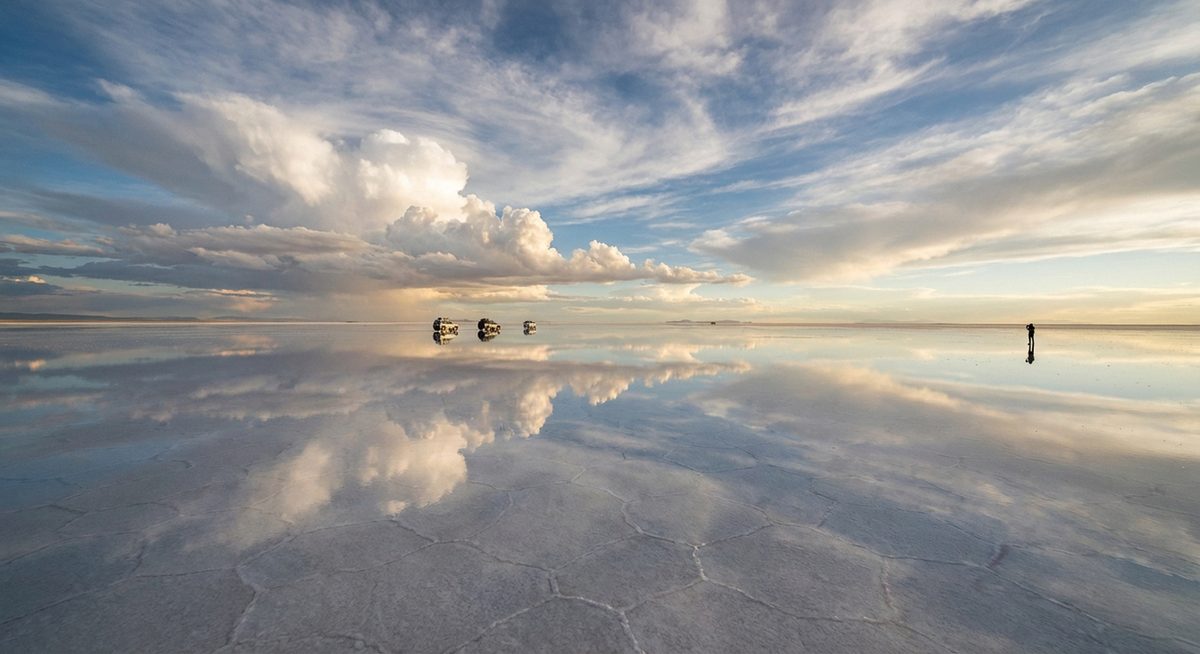
The Salar de Uyuni is the world's largest salt flat, covering over 10,000 square kilometers at an elevation of 3,656 meters. During the rainy season (December to April), a thin layer of water transforms it into the world's largest natural mirror, reflecting the sky with such precision that the horizon disappears. During the dry season (May to November), the surface dries into hexagonal salt patterns that stretch to the horizon. Three-day tours from the town of Uyuni cross the salt flat, pass through Eduardo Avaroa National Reserve with its colored lagoons and geysers, and can continue to the Chilean border at San Pedro de Atacama.
La Paz
Bolivia's de facto capital sits in a vast canyon at 3,640 meters, with the snow-capped peak of Illimani towering behind it. The city is chaotic, colorful, and utterly unique. The teleférico cable car system offers aerial views across the urban sprawl. The Witches' Market sells dried llama fetuses and traditional remedies. Cholita wrestling puts a distinctly Bolivian spin on entertainment. The food scene ranges from street stalls serving salteñas to increasingly sophisticated restaurants in the Sopocachi neighborhood.
Sucre
Bolivia's constitutional capital and arguably its most beautiful city, Sucre is a whitewashed colonial gem at 2,810 meters. The altitude is more comfortable than La Paz, the pace is slower, and the architecture is well-preserved. The city has excellent museums, affordable Spanish schools, and one of the continent's best dinosaur track sites at Cal Orcko, a limestone cliff face with over 5,000 footprints from at least eight different dinosaur species.
Potosí
Once one of the richest cities in the world thanks to the silver mines of Cerro Rico, Potosí sits at 4,090 meters and carries the weight of its colonial history in every street. Visiting the mines is an intense and sometimes confronting experience. Miners still work in conditions that have barely changed in centuries, and tours involve crawling through narrow tunnels, meeting working miners, and understanding a chapter of history that shaped the global economy.
Lake Titicaca (Bolivian Side)
While many travelers visit Lake Titicaca from the Peruvian side at Puno, the Bolivian town of Copacabana offers a quieter and cheaper base. From here, boats run to Isla del Sol, considered the birthplace of the Inca civilization. The island has no cars, only walking trails connecting Inca ruins with small communities. It is one of the most peaceful spots in Bolivia and a natural stopover if you are crossing the Peru-Bolivia border. If you are planning a broader trip through Peru, the lake makes a perfect transition point between the two countries.
Madidi National Park
Bolivia's slice of the Amazon is accessed through the town of Rurrenabaque, reachable by a dramatic 18-hour bus ride from La Paz or a short flight. Madidi National Park is one of the most biodiverse areas on Earth, with jungle tours ranging from one to five days. You can spot monkeys, caimans, macaws, and if you are very fortunate, jaguars. The pampas tours on the Yacuma River are a more budget-friendly alternative and offer virtually guaranteed wildlife sightings including pink river dolphins.
Getting to Bolivia from Peru
The most popular border crossing is Desaguadero, on the shore of Lake Titicaca between Puno (Peru) and La Paz (Bolivia). The crossing is straightforward: take a bus from Puno to the border (about 2.5 hours), walk across the bridge, complete immigration on both sides, and catch a bus to La Paz (about 3 hours). Several companies run direct Puno-to-La Paz buses that handle the border process for you.
The Copacabana crossing is another option. Buses run from Puno to Copacabana (about 3 hours including the border), and from Copacabana you can continue to La Paz. This route is ideal if you want to stop at Lake Titicaca on the Bolivian side.
Flights connect Lima to La Paz via Santa Cruz, though they are more expensive than overland options. If time is limited and budget allows, the flight saves two full days of travel.
Practical Tips for Traveling in Bolivia
Altitude Preparation
La Paz sits at 3,640 meters, Potosí at 4,090 meters, and the Salar de Uyuni at 3,656 meters. If you are coming from sea level, altitude sickness is a real concern. The best strategy is to acclimatize gradually: spend a few days in Cusco or Puno in Peru (both above 3,000 meters) before crossing into Bolivia. Drink coca tea, stay hydrated, avoid alcohol for the first day or two, and do not push yourself physically until your body adjusts. Most people adapt within 48 to 72 hours. For more on preparing for high-altitude travel, see our essential tips for traveling to Peru.
Money and Costs
The Bolivian currency is the boliviano (BOB). As of 2026, one US dollar buys approximately 6.9 bolivianos. ATMs are available in all cities and most larger towns, but carry cash for rural areas and smaller villages. Bolivia is remarkably affordable: budget travelers can get by on $25 to $40 per day. A basic hotel room costs $8 to $20, street food meals are $1 to $3, and local buses between cities cost $3 to $15 depending on distance.
Safety Considerations
Bolivia is generally safe for tourists, though petty crime (pickpocketing, bag snatching) occurs in La Paz, especially around the bus terminal and markets. Avoid express taxis hailed on the street in La Paz; use radio taxis or ride-hailing apps instead. Protests and road blockades are a regular part of Bolivian civic life and can disrupt travel plans without warning. Check local news before long bus journeys and have flexible dates built into your itinerary. For broader safety context in the region, read our guide on whether Peru is safe for tourists.
Transport
Bolivia's bus network is extensive and cheap but not always comfortable. Long-distance routes cross mountain passes and rough roads, and journeys that look short on a map can take much longer than expected. Night buses between major cities (La Paz to Sucre, La Paz to Cochabamba) are the most common approach. For the Uyuni salt flat, most people book organized tours from the town of Uyuni or from Tupiza to the south.
Food
Bolivian cuisine is hearty and starch-heavy, built around potatoes, rice, corn, and meat. Salteñas are the quintessential Bolivian snack: baked empanadas filled with a sweet-savory stew eaten in the morning. Pique macho is a mountain of chopped steak, sausage, fries, and chili peppers. Silpancho is a breaded beef cutlet over rice and potatoes topped with a fried egg. Street food is plentiful, cheap, and generally safe if you eat from busy stalls with high turnover.
How Long to Spend in Bolivia
A minimum of 10 days gives you time to visit La Paz, the Salar de Uyuni, and either Sucre or Lake Titicaca. Two to three weeks allows a more complete circuit: La Paz, Death Road, Lake Titicaca, Sucre, Potosí, Uyuni, and possibly the Amazon. A month or more lets you explore at a relaxed pace with room for unexpected detours and delays, which are common in Bolivia.
Many travelers combine Bolivia with Peru as part of a broader South American loop. A three-week itinerary covering Lima, Cusco, the Sacred Valley, Lake Titicaca, La Paz, and the Salar de Uyuni is a classic route that captures highlights of both countries. If you have even more time, consider adding Futaleufú river rafting in Chile or extending into northern Argentina.
Frequently Asked Questions
Do I need a visa to visit Bolivia?
Visa requirements depend on your nationality. US citizens need a visa, which can be obtained in advance at a Bolivian consulate or at the border (about $160 USD). Citizens of the EU, UK, Canada, Australia, and most South American countries do not need a visa for stays up to 90 days. Always check the latest requirements before traveling as policies change.
Is Bolivia safe for solo travelers?
Bolivia is generally safe for solo travelers who take standard precautions. The main risks are petty theft in larger cities and road conditions on long bus journeys. Solo female travelers report some street harassment but describe it as less aggressive than in some other South American countries. The backpacker trail is well-established, so meeting other travelers is easy.
What is the best time of year to visit Bolivia?
The dry season (May to October) offers the most reliable weather for travel and trekking. The Salar de Uyuni is best during the rainy season (January to March) for the mirror effect, or during the dry season for hexagonal salt patterns and easier road access. La Paz and the highlands are cold year-round, with nights below freezing in winter (June to August).
How do I get from Peru to Bolivia?
The most common route is by bus from Puno to La Paz via the Desaguadero or Copacabana border crossings. The journey takes 6 to 8 hours including immigration. Direct buses handle the border formalities. You can also fly from Lima to La Paz with a connection in Santa Cruz, though this is more expensive.
How much does a Salar de Uyuni tour cost?
A standard three-day, two-night tour from Uyuni costs $100 to $180 USD per person in a shared group, including transport, accommodation in basic salt hotels and refugios, and meals. Private tours and upgraded accommodations cost $250 to $500 per person. One-day tours of just the salt flat start at about $30 to $50.
Is altitude sickness a problem in Bolivia?
Yes. Most major destinations in Bolivia are above 3,500 meters. Altitude sickness is common among visitors arriving from low elevations. Symptoms include headache, nausea, fatigue, and shortness of breath. Acclimatize gradually, drink plenty of water, try coca tea, and avoid strenuous activity for the first 24 to 48 hours. If symptoms worsen, descend to a lower altitude.
Can I use US dollars in Bolivia?
US dollars are not widely accepted for everyday purchases in Bolivia. You need bolivianos for most transactions. Exchange dollars at banks or casas de cambio in major cities. ATMs dispense bolivianos and are available in all cities and larger towns. Carry cash for rural areas where electronic payments are not an option.
Is the Death Road bike ride worth doing?
The North Yungas Road (Death Road) mountain bike descent from 4,700 meters to 1,200 meters is one of Bolivia's most popular tourist activities. The ride is thrilling, with steep drops, narrow sections, and dramatic jungle scenery. Reputable operators provide quality bikes, helmets, and support vehicles. It is worth doing if you enjoy adventure activities, but choose a well-reviewed company and do not skimp on safety.
What language is spoken in Bolivia?
Spanish is the official language and the one used in tourism, government, and business. However, 36 indigenous languages are also recognized, with Quechua and Aymara being the most widely spoken. In rural areas and indigenous communities, Spanish may be a second language. English is spoken at a basic level in tourist areas but is not common outside them.
How does Bolivia compare to Peru for travel?
Bolivia is cheaper, less touristy, and rougher around the edges than Peru. Infrastructure is more basic, buses are slower, and tourist facilities are simpler. In exchange, you get more authentic cultural experiences, fewer crowds, and landscapes that are equally spectacular. Peru has better-developed tourist infrastructure, more international flights, and more variety in cuisine. Most travelers who visit both enjoy the contrast.