Top 6 Unforgettable Things to Do in Peru: Adventures, Culture, and Natural Wonders
Peru is a country built for doing, not just seeing. While its landscapes and historical sites are spectacular to look at, the real magic happens when you lace up your hiking boots, push a kayak into a jungle river, or sit down at a Lima market stall to taste ceviche made minutes ago from fish pulled out of the Pacific. The best things to do in Peru engage all your senses and leave you with stories that last far longer than photographs.
This guide focuses on the top 6 experiences in Peru that consistently rank as the most memorable for travelers. Each one takes you deep into a different facet of the country, from its ancient Inca heritage to its unmatched biodiversity, from its world-class cuisine to its adrenaline-fueled adventure sports. If you are still deciding where to go, start with our overview of the top 10 destinations to visit in Peru.
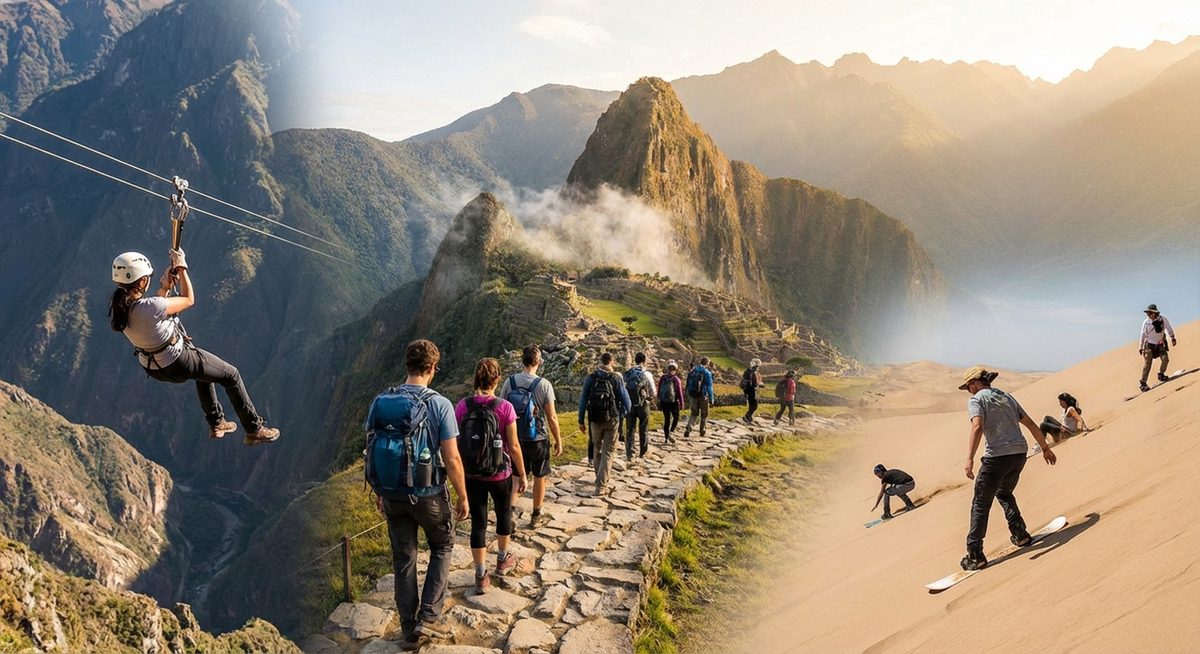
1. Hike the Inca Trail to Machu Picchu
The Inca Trail is not just a hike; it is a pilgrimage through history. This 43-kilometer route follows a section of the vast Inca road network that once connected the empire's far-flung territories, passing through cloud forests draped in orchids and bromeliads, across alpine passes at over 4,200 meters, and past a series of lesser-known but beautifully preserved Inca ruins that most visitors to Machu Picchu never see.
The classic four-day trek begins at Kilometer 82 along the railway line from Cusco and ends at the Sun Gate, Inti Punku, which frames the first heart-stopping view of Machu Picchu spread out on the ridge below. The final morning involves waking before dawn and hiking the last stretch by headlamp, arriving at the Sun Gate as the first rays of sunlight illuminate the citadel. It is, without exaggeration, one of the most powerful moments in travel.
Permits are required and limited to 500 people per day, including porters and guides, so booking four to six months in advance is essential during the peak season from May to September. The trail itself is demanding but not technically difficult. The highest point, Dead Woman's Pass at 4,215 meters, requires steady climbing but no special equipment beyond good hiking boots and rain gear.
For those who want a less crowded alternative, the trek to Choquequirao offers equally stunning ruins with a fraction of the foot traffic. The Salkantay Trek and Lares Trek are other popular options that end at Machu Picchu via different routes through the Andes.
2. Explore the Amazon Rainforest
Peru's Amazon basin covers over 780,000 square kilometers of primary tropical rainforest, representing one of the most biologically rich environments on the planet. A trip into the Peruvian Amazon is unlike any other travel experience. The sheer density of life is overwhelming: a single hectare of rainforest can contain more tree species than the entire United Kingdom, and the soundtrack of birdsong, insect calls, and howler monkey roars creates an immersive wall of sound that begins before dawn and never truly stops.
The two main entry points are Puerto Maldonado in the southeast and Iquitos in the northeast. Puerto Maldonado, a short flight from Cusco, provides access to the Tambopata National Reserve, where jungle lodges range from rustic to surprisingly comfortable. Guided walks reveal leaf-cutter ant highways, poison dart frogs in electric blue and orange, and the enormous buttress roots of ceiba trees. Night excursions along rivers spotlight caimans, and early-morning birdwatching from canopy towers can yield sightings of macaws, toucans, and the magnificent harpy eagle.
Iquitos, accessible only by air or river, is the gateway to the deeper Amazon. Multi-day boat expeditions travel up the Napo or Marañón rivers, stopping at indigenous communities and remote oxbow lakes where giant river otters and pink dolphins hunt. The biodiversity here is staggering, and spending even three days in the jungle will fundamentally change how you understand the natural world. Explore the remarkable plants of the tropical rainforest and learn about the cutest animals you might encounter.
3. Dive Into Lima's Food Scene and World-Class Museums
Lima has earned its place as the gastronomic capital of the Americas through a cuisine that blends indigenous Peruvian ingredients with Spanish, African, Chinese, and Japanese influences accumulated over centuries of migration. The result is a food culture of extraordinary depth and creativity, from humble street-side anticucherías grilling beef hearts over charcoal to the avant-garde tasting menus at Central, where chef Virgilio Martínez constructs dishes based on ingredients sourced from specific Peruvian ecosystems and altitudes.
Begin your culinary exploration in the Surquillo market, where vendors hawk fresh ceviche, tropical fruits you have never seen before, and steaming bowls of caldo de gallina. Move on to Barranco for creative small plates and craft cocktails, or head to the Chinatown district for chifa, the Peruvian-Chinese fusion cuisine that has become a staple of everyday eating. A ceviche lunch at La Mar or a lomo saltado at Isolina will convince you that Peruvian food deserves every accolade it has received.
Beyond the table, Lima holds some of South America's finest museums. The museums of Lima span thousands of years of history, from the Larco Museum's world-class collection of pre-Columbian gold, textiles, and ceramics to the haunting catacombs beneath the San Francisco monastery. The Museo de la Nación covers Peru's entire historical arc in a single building, and the Museum of Contemporary Art (MAC) showcases the vibrant current of Peruvian visual arts.
If you have an afternoon to spare, the beaches of Lima offer a surprising escape from the urban energy. The coastline stretching south from Miraflores to Chorrillos is lined with boardwalks and surf breaks that attract locals year-round.
4. Fly Over the Nazca Lines
Nothing quite prepares you for the moment you look down from a small aircraft and see a perfectly proportioned hummingbird, 90 meters long, etched into the barren desert floor below. The Nazca Lines, created between 500 BCE and 500 CE by the Nazca civilization, are among the most enigmatic archaeological features on Earth. Over 1,500 geoglyphs, including a spider, a monkey, a whale, a condor, and dozens of geometric shapes, cover an area of nearly 450 square kilometers of arid plateau in southern Peru.
The lines were made by removing the reddish pebbles that cover the desert surface to reveal the lighter ground beneath. In this dry, windless environment, the exposed lines have survived for over two millennia with minimal erosion. Their scale is almost impossible to comprehend from the ground, which is precisely what makes the aerial perspective so extraordinary. The 30-minute flights from Nazca airport loop over the major figures while the pilot banks the aircraft to give passengers on both sides clear views.
The debate over the purpose of the Nazca Lines has generated theories ranging from the plausible to the fantastical. The most widely accepted explanation is that they served ritual or astronomical purposes, with some lines aligning with solstice sun positions and others pointing toward water sources. German mathematician Maria Reiche devoted her life to studying and protecting the lines, and her former home near Nazca is now a small museum dedicated to her work.
Beyond the lines themselves, the Nazca region holds several other archaeological sites worth visiting, including the Chauchilla cemetery and the Cantalloc aqueducts, an underground irrigation system still functioning after 1,500 years.
5. Experience Lake Titicaca and Its Floating Islands
At 3,812 meters above sea level, Lake Titicaca is the highest navigable body of water in the world and the largest lake in South America by volume. Shared between Peru and Bolivia, the lake holds deep spiritual significance in Andean cosmology. The Inca creation myth holds that the god Viracocha rose from the lake's depths to create the sun, the moon, and the first human beings. Standing on the shore and looking out across water so blue it merges seamlessly with the sky, it is easy to understand why ancient peoples considered this place sacred.
The most remarkable human achievement on the lake belongs to the Uros people, who have built and maintained artificial floating islands from layers of dried totora reeds for hundreds of years. The islands, which must be constantly replenished as the lower layers decompose, support entire communities complete with houses, schools, and even a radio station. Visiting the Uros islands is a standard day trip from Puno, the lakeside city that serves as the main base for exploration.
For a deeper experience, the natural islands of Taquile and Amantani offer overnight homestays with local families. On Taquile, men knit intricate textiles, a tradition recognized by UNESCO as an Intangible Cultural Heritage. On Amantani, families host travelers for dinner and an evening of traditional music and dancing, followed by a sunrise hike to one of the island's hilltop temples. These stays provide an intimate window into a way of life that has changed remarkably little over the centuries.
The broader Puno region is also worth exploring for its festivals. The Fiesta de la Candelaria in February fills the streets with elaborate costumes, brass bands, and dances that blend Catholic and pre-Columbian traditions in a spectacle rivaling Carnival in Rio.
6. Tackle Adventure Sports in the Cusco Region
Cusco and its surroundings have become one of South America's premier adventure sports destinations, offering an adrenaline menu that takes full advantage of the region's dramatic topography. The combination of deep river valleys, high mountain passes, and steep terrain creates ideal conditions for everything from white-water rafting to mountain biking, paragliding to zip-lining.
White-water rafting on the Urubamba River is one of the most accessible adventures, with sections ranging from gentle Class II rapids suitable for families to challenging Class IV stretches that will test experienced paddlers. The Apurimac River, deeper in the canyon country west of Cusco, offers multi-day rafting expeditions through some of the most remote and spectacular gorges in the Andes.
Mountain biking descents from the highlands to the jungle are another highlight. The route from Abra Málaga pass down to the town of Quillabamba drops over 3,500 meters in elevation, passing from snow-capped peaks through cloud forest and into the subtropical lowlands in a single day. The infamous "Death Road" in Bolivia gets more press, but Peru's downhill routes are equally thrilling and far less crowded.
For a completely different kind of rush, consider spending a night in one of Peru's transparent sky domes, suspended on a cliff face or perched on a mountain ridge. These glass-walled accommodations offer 360-degree views of the Andes sky, including some of the most spectacular stargazing in the Southern Hemisphere. It is not exactly a sport, but the vertigo of sleeping in a glass pod on the side of a mountain qualifies as an adventure.
Rock climbing, horseback riding through the Sacred Valley, and zip-line courses that cross entire valleys round out the adventure options. Whatever your skill level and comfort zone, Cusco and its surroundings have something that will push your boundaries and fill your memory card.
How to Plan Your Peru Activities
Fitting all six of these things to do in Peru into a single trip is ambitious but achievable with three weeks. Here is a practical framework:
- Days 1-3: Lima. Spend time eating your way through the city, visiting museums, and exploring beaches.
- Days 4-5: Fly to Cusco. Acclimatize, explore the city's hidden gems, and prepare for the trek.
- Days 6-9: Hike the Inca Trail to Machu Picchu.
- Days 10-11: Adventure sports in the Sacred Valley.
- Days 12-14: Fly to Puerto Maldonado for three days in the Amazon.
- Days 15-17: Travel to Puno for Lake Titicaca, including a homestay on Amantani.
- Days 18-19: Bus or fly to Nazca for the overflight.
- Day 20-21: Return to Lima for final meals and departure.
For wildlife enthusiasts, add side trips to see the Andean cock-of-the-rock, Peru's national bird, or visit the habitats of the must-see animals in Peru. Cultural travelers should explore the history and use of palo santo or learn about the ayahuasca ceremony, one of Peru's most profound spiritual traditions.
Frequently Asked Questions About Things to Do in Peru
What is the best thing to do in Peru for first-time visitors?
Hiking the Inca Trail to Machu Picchu remains the single most iconic experience Peru has to offer. It combines physical challenge, historical immersion, and one of the most dramatic reveals in travel. If you only do one thing in Peru, make it this. For those who cannot commit to the four-day trek, the train from Ollantaytambo followed by a bus up to the ruins is a comfortable and equally rewarding alternative.
How much does it cost to do the top activities in Peru?
Costs vary widely. The Inca Trail with a licensed operator runs $500 to $900 USD for the four-day trek, including permits, guides, porters, meals, and camping gear. A three-day Amazon lodge stay costs $200 to $600 depending on the lodge level. Nazca overflight tickets range from $80 to $120. Lake Titicaca homestays can be arranged for as little as $30 per night including meals. Overall, Peru offers excellent value compared to many adventure travel destinations.
Is Peru good for adventure sports?
Peru is one of the best adventure sports destinations in South America. The Cusco region alone offers white-water rafting, mountain biking, paragliding, zip-lining, rock climbing, and horseback riding. The diversity of terrain, from coastal deserts to Andean peaks to jungle rivers, means there is an adventure to suit every skill level and interest. Many activities are available year-round, though the dry season from May to October is optimal for most.
Can you visit the Amazon and Machu Picchu in the same trip?
Absolutely. A common itinerary flies from Lima to Cusco, spends several days exploring the Sacred Valley and Machu Picchu, then takes a short flight from Cusco to Puerto Maldonado for a jungle lodge stay before returning to Lima. This combination can be done comfortably in 10 to 12 days and covers two of Peru's most different and most impressive ecosystems.
What should I pack for activities in Peru?
Layers are essential, as temperatures can range from freezing at altitude to tropical in the jungle within the same trip. Key items include waterproof hiking boots, a lightweight rain jacket, sun protection (hat, sunscreen, sunglasses), insect repellent for the Amazon, and a warm fleece or down jacket for highland evenings. A refillable water bottle and altitude sickness medication like acetazolamide are also recommended.
Is it safe to do adventure sports in Peru as a solo traveler?
Yes, Peru is well-suited for solo adventure travelers. Reputable tour operators in Cusco, Lima, and other hubs run group excursions for activities like rafting, trekking, and mountain biking, making it easy to join others. Always choose licensed operators with good safety records, and let someone know your itinerary. The backpacker infrastructure in Peru is well-developed, so meeting fellow travelers for group activities is straightforward.
Do I need to speak Spanish to enjoy activities in Peru?
While speaking Spanish enriches the experience, it is not essential for the main tourist activities. Most tour operators in popular areas like Cusco, Lima, and the Amazon offer English-speaking guides. However, learning basic Spanish phrases will help in markets, local restaurants, and off-the-beaten-path destinations where English is less common. A translation app on your phone is a useful backup.
What is the most unique cultural experience to have in Peru?
A homestay on the islands of Lake Titicaca is one of the most culturally immersive experiences available. Spending a night with a local family on Amantani or Taquile Island offers a genuine window into traditional Andean life, including shared meals, textile weaving demonstrations, and evening music and dance. It is an experience that connects you with Peruvian culture on a personal level that no museum or guided tour can replicate.
Your Peru Adventure Starts Now
The top 6 things to do in Peru barely scratch the surface of what this extraordinary country offers. Each activity on this list connects you with a different dimension of Peru: its ancient heritage, its staggering natural beauty, its rich culinary tradition, and its capacity for pure, unfiltered adventure. The common thread is that all of them require participation, not just observation. Peru is a country that rewards those who engage with it fully.
Ready to plan your route? Start with our complete guide to the top 10 destinations in Peru, learn about the unique Peruvian hairless dog, or explore the eerie side of the country in our guide to paranormal Peru. However you build your itinerary, these six experiences belong at its core.